
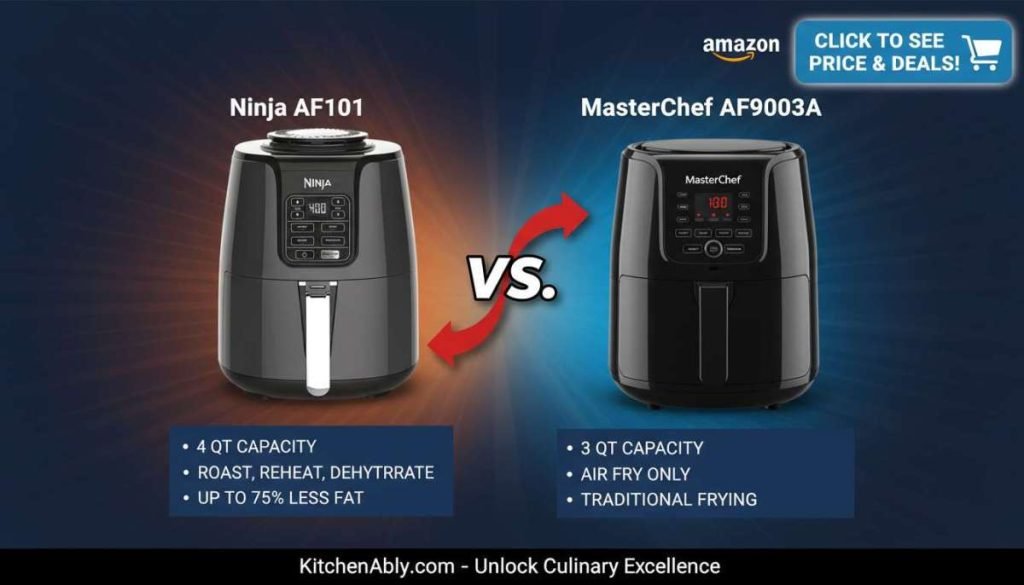
Choosing the right air fryer isn’t just about crisping fries—it’s about balancing speed, consistency, capacity, and overall convenience in your kitchen. The Ninja AF101 and the MasterChef AF9003A are two popular options, each designed with different strengths.
While the Ninja emphasizes fast cooking and versatility, the MasterChef aims to deliver simple, crispy results in a compact design. In this comparison, we’ll break down how these two models stack up in key areas like cooking chamber size, frying quality, cooking speed, preheat time, and temperature stability to help you decide which one better fits your cooking style.
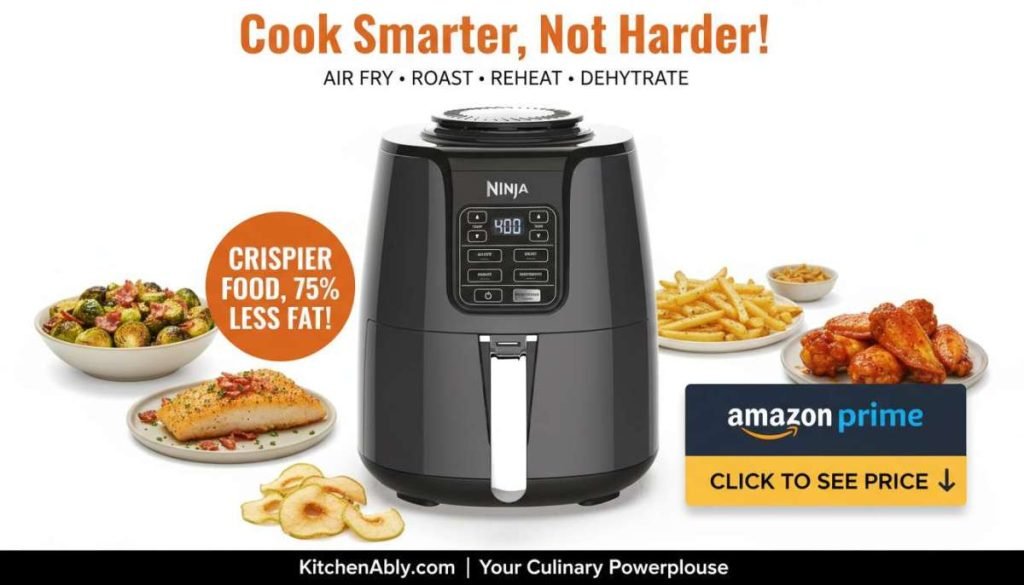
Ninja AF101 vs MasterChef AF9003A Comparison
| Feature | Ninja AF101 | MasterChef AF9003A |
|---|---|---|
| Air Frying | 7.7 | 6.8 |
| Cooking Speed | 8.3 | 6.1 |
| Cooking Versatility | 8.1 | 6.5 |
| Frying Quality | 7.2 | 7.5 |
| Temperature Stability | 7.3 | 6.4 |
| Cooking Capacity | 6.8 | 7.3 |
| Size (Counter Space) | 7.5 | 8.0 |
| Overall | 7.7 | 7.1 |
Strengths & Weaknesses
Ninja AF101
Pros:
- Cooks especially fast and holds consistent temperature.
- Very versatile—features four modes (Air Fry, Roast, Reheat, Dehydrate), wide temperature range, and adjustable fan speeds.
- Compact footprint, suitable for smaller kitchens.
Cons:
- Small overall capacity and cooking surface area, limiting batch cooking scaling.
- Some foods may cook unevenly (a portion under- or over-cooked).
MasterChef AF9003A
Pros:
- Produces slightly better-quality fried food—with well-browned, crispy results.
- Decent surface area relative to capacity allows better arrangement for food.
- Compact design; takes up somewhat less counter space.
Cons:
- Slower cooking speed—though preheating is fairly quick, cooking runs slowly overall.
- Less versatile: only one fan speed, fewer cooking modes, and a narrow temperature range.
- Touchscreen interface is reportedly unresponsive.
Ninja AF101 vs MasterChef AF9003A Air Fryer – Side-by-Side Review
Design & Build Quality
The Ninja AF101 and the MasterChef AF9003A approach design very differently.
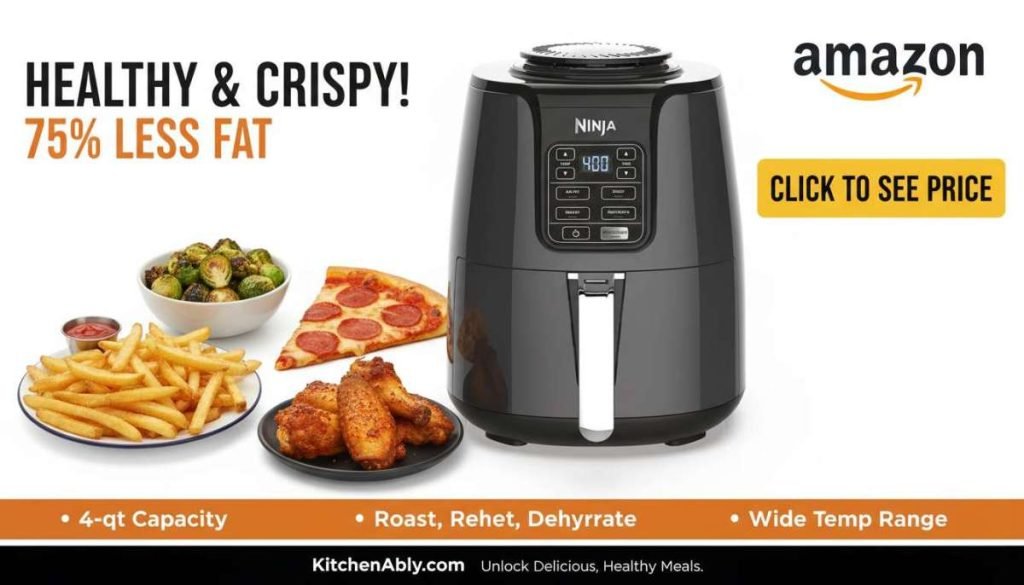
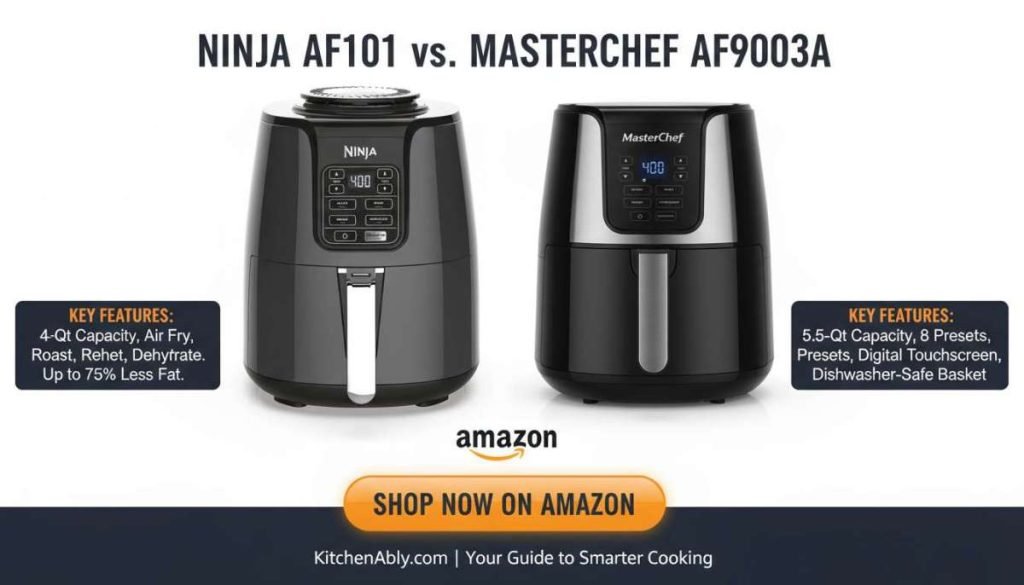
- Ninja AF101 comes in a sleek black-and-gray finish with a compact footprint. It feels solidly built, with intuitive physical buttons and a simple digital display. Its smaller basket makes it best for small families or individuals, but the overall construction gives a premium, durable impression.
- MasterChef AF9003A, on the other hand, has a more basic design. It’s slightly larger in cooking surface area despite being compact on the counter. The glossy black exterior looks nice at first, but the touchscreen controls can sometimes feel unresponsive compared to Ninja’s straightforward buttons.
When it comes to design, the Ninja wins for reliability and user-friendly controls, while the MasterChef gives you a bit more room for arranging food inside the basket.
Cooking Performance
Performance is where the two models really separate.
- Ninja AF101 is known for its speed. It heats up quickly, maintains stable cooking temperatures, and handles a wide range of recipes well. Fries, chicken wings, and vegetables cook faster here than in most budget fryers. Its even heat distribution, combined with fan speed control, helps deliver consistent results, though sometimes smaller batches come out slightly uneven.
- MasterChef AF9003A takes longer to finish the same recipes. While it’s slower, it often produces slightly crispier, well-browned results—especially on fried foods. However, with only one fan speed and a limited temperature range, it doesn’t offer the same flexibility as the Ninja.
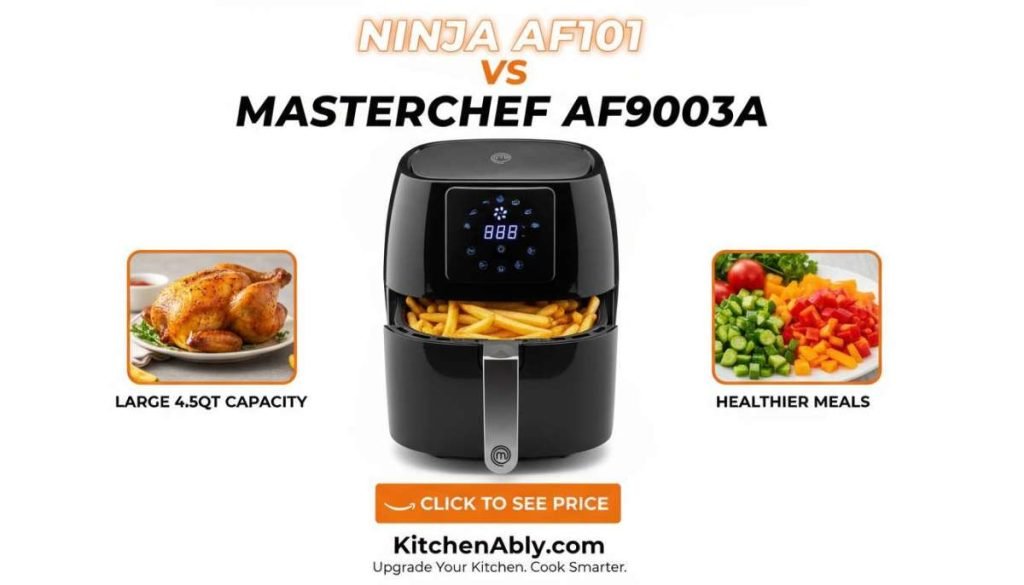
So, if speed and versatility matter most, Ninja has the edge. If crisp texture is your top priority and you don’t mind waiting longer, MasterChef holds its ground.
Versatility & Feature
The Ninja AF101 includes multiple cooking modes—Air Fry, Roast, Reheat, and even Dehydrate. You also get control over fan speeds, which adds versatility for different recipes.
The MasterChef AF9003A is much simpler. It focuses almost entirely on air frying with fewer modes and no adjustable fan settings. While it does a good job frying, it lacks the multi-functionality that makes Ninja useful for more than just crispy snacks.
Ease of Use & Maintenance
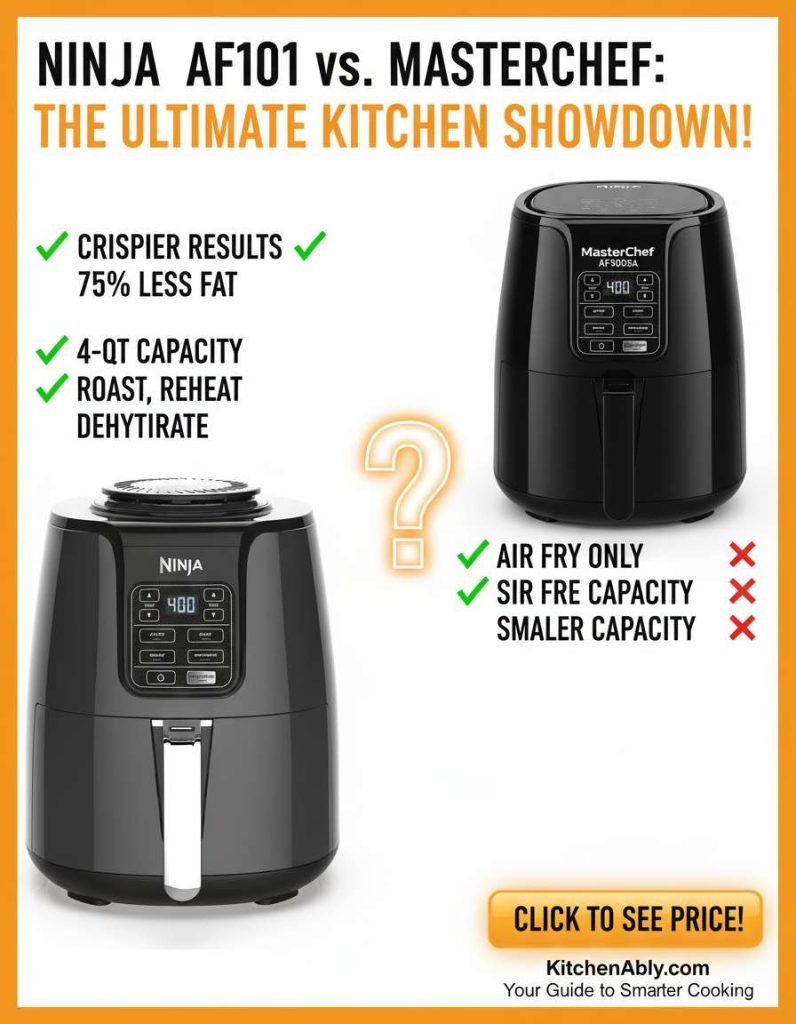
Both models are easy to clean with dishwasher-safe baskets.
- Ninja AF101’s interface is straightforward: push-button controls, responsive settings, and clear presets.
- MasterChef AF9003A suffers slightly because of its touchscreen—it looks modern, but users often find it unresponsive.
If you want no-fuss operation, Ninja is the safer bet.
Cooking Chamber (Capacity & Surface Area)
- Ninja AF101
It has a measured internal capacity of about 4.2 quarts with a cooking surface of roughly 49.9 square inches. Though compact, it’s thoughtfully designed for small kitchens. - MasterChef AF9003A
Slightly smaller overall at around 3.6 quarts, but with more usable cooking surface area. It’s efficient in how it uses that space, allowing better arrangement of food items.
Verdict: Ninja has more volume, but MasterChef gives you better layout flexibility in a compact form.
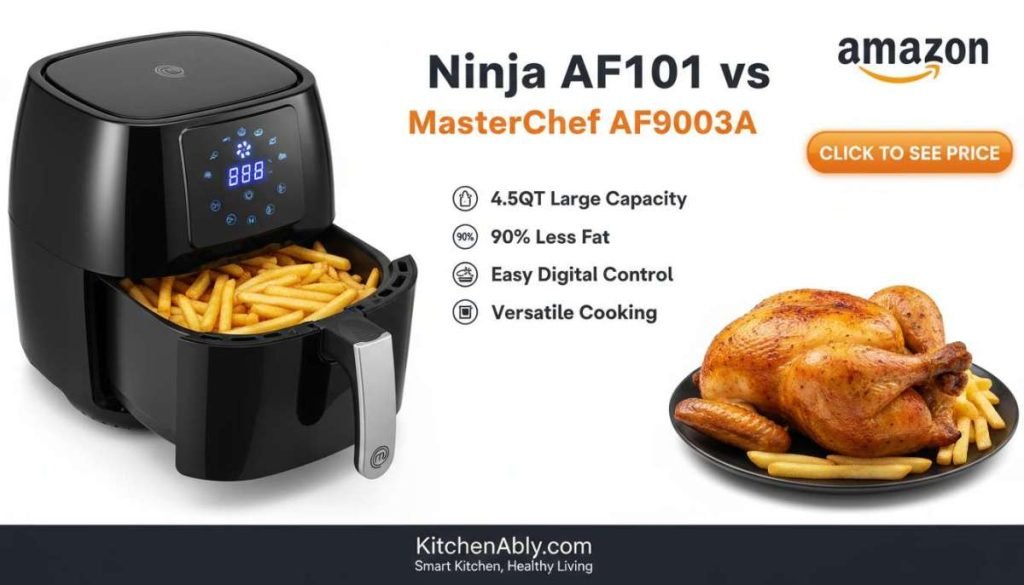
Frying Quality (Crispiness & Browning)
- Ninja AF101
Delivers crispy, golden results with good moisture retention—yet some small batches can cook unevenly. - MasterChef AF9003A
Produces somewhat better overall crispness and browning compared to the Ninja, making its fried food slightly more appealing.
Verdict: MasterChef narrowly wins here—slightly superior browning despite its simplicity.
Cooking Speed (Time to Cook)
- Ninja AF101
Impressively fast—rated around 8.3 to 8.4/10 for cooking speed—making it noticeably quicker than most rivals. - MasterChef AF9003A
Slower by comparison, with a cooking speed rating near 6.1/10, making it significantly slower than the Ninja.
Verdict: Ninja wins easily—goes from cold to done much faster.
Preheat Speed (Time to Reach Target Temp)
Detailed preheat speed scores for both models aren’t directly available, but we can infer:
- Ninja AF101
In broader tests, similar Ninja models preheat in about 2 minutes 40 seconds, and maintain excellent stability during cooking. Read Manual. - MasterChef AF9003A
Specific preheat numbers aren’t provided, but its overall slower performance suggests preheat may also lag behind Ninja’s.
Verdict: The Ninja likely preheats faster based on its overall performance advantage.
Temperature Stability (Consistency & Recovery)
- Ninja AF101
Holds heat remarkably well with a stability score around 7.3/10. Tests show it recovers and maintains temperature tightly. - MasterChef AF9003A
Less consistent, with a stability score around 6.4/10, meaning more temperature fluctuation and slower recovery when opening the drawer.
Verdict: Ninja clearly outperforms here—better heat consistency, more predictable results.
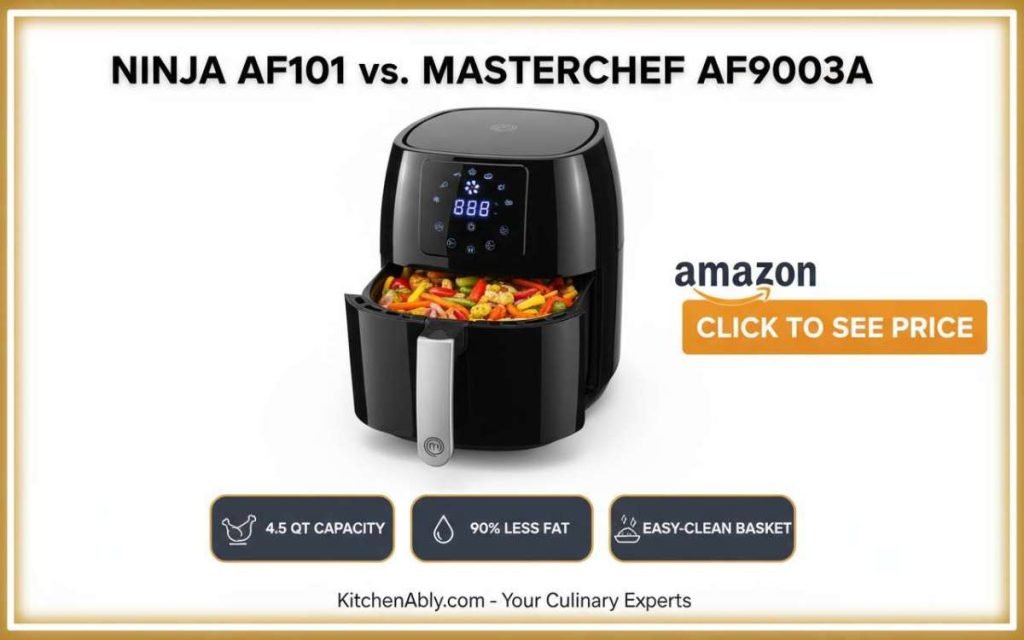
Side-by-Side Summary
| Feature | Ninja AF101 | MasterChef AF9003A |
|---|---|---|
| Cooking Chamber | Larger capacity (~4.2 qt) | Slightly smaller capacity (~3.6 qt), but roomier layout |
| Frying Quality | Great overall, slight unevenness | Slightly better crispiness and browning |
| Cooking Speed | Very fast (~8.3–8.4/10) | Slower (~6.1/10) |
| Preheat Speed | Likely faster (inferred faster performance) | Not rated, likely slower |
| Temperature Stability | Excellent (~7.3/10), rock-solid heat control | Less stable (~6.4/10) |
Pros & Cons at a Glance
Ninja AF101
✔️ Fast cooking speed
✔️ Multiple modes and versatility
✔️ Consistent temperature control
❌ Smaller cooking capacity
❌ Some uneven cooking with dense batches
MasterChef AF9003A
✔️ Slightly better crispness in frying
✔️ Decent cooking surface for its size
✔️ Compact, space-saving design
❌ Slower cooking times
❌ Limited versatility
❌ Touchscreen isn’t very responsive
If you want an air fryer that’s fast, versatile, and reliable for everyday use, the Ninja AF101 is the better choice. It’s a great fit for small households or anyone who wants more than just frying—like roasting or dehydrating.
The MasterChef AF9003A is best for those who mainly care about crispy results and don’t mind slower cooking or fewer functions. It’s a more “basic” air fryer, good for occasional use, but not as well-rounded as the Ninja.
For most users, the Ninja AF101 offers a stronger balance of speed, versatility, and ease of use, making it the smarter long-term pick.
Conclusion
Both air fryers have their merits, but they cater to slightly different needs. The Ninja AF101 is the clear winner for most households—it’s faster, more consistent, and offers versatile features that go beyond air frying.
On the other hand, the MasterChef AF9003A appeals to those who value crisp frying results above all else and don’t mind slower cooking or fewer functions. If you want a reliable, all-around performer, go with the Ninja. If you’re after a no-frills fryer that simply gets the crisp done, the MasterChef will serve you well.